Remembering O’odham Foodways Through Community
Mazey Ortega
Written by Trinity Norris, Edited by Winona Little Owl-Ignacio, Graphic design by Aracely Rodriguez
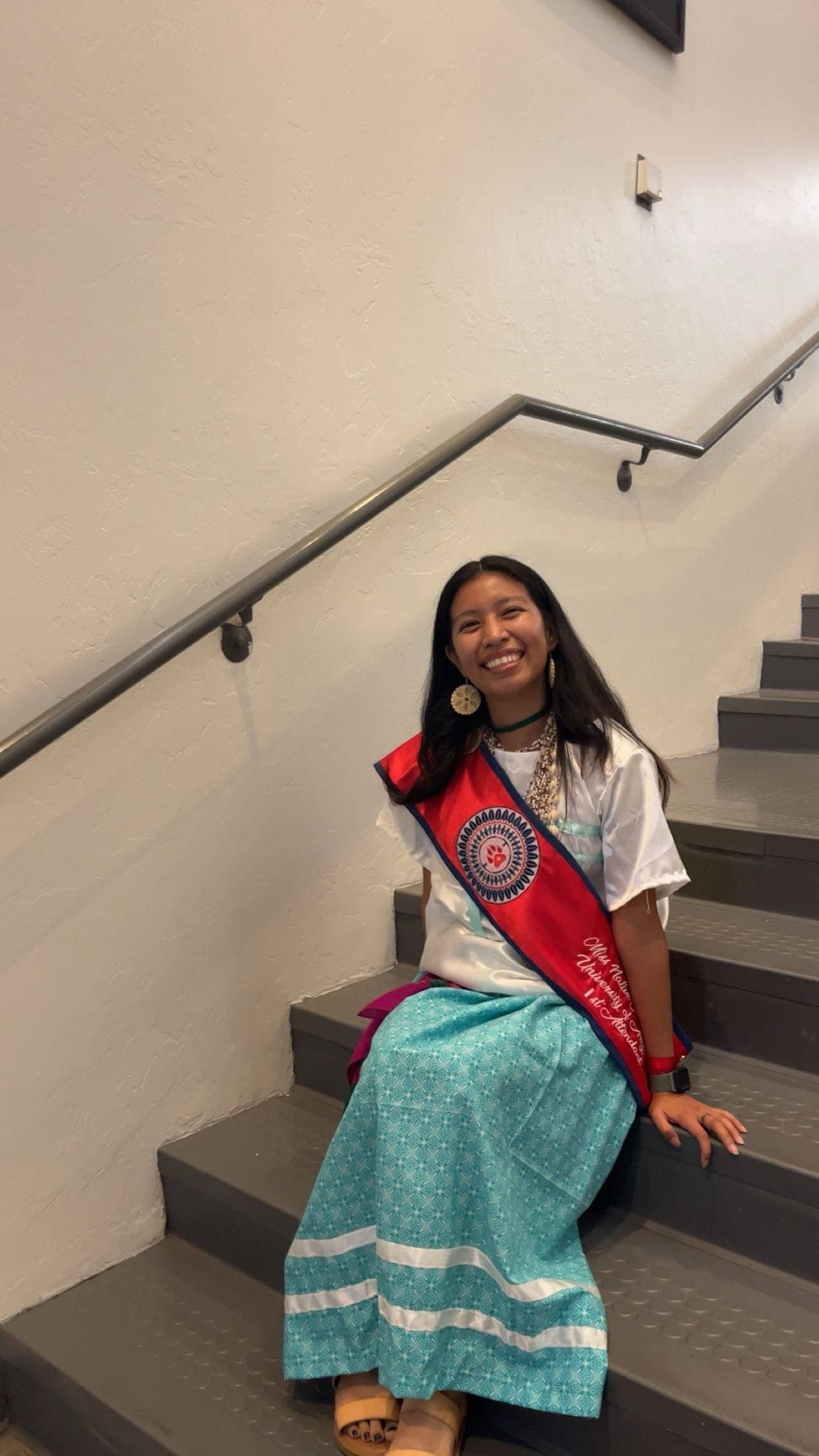
For Mazey Ortega, some of her strongest memories of bahidaj begin with simply following along.
Growing up between San Pedro and her father’s village, Mazey spent much of her childhood surrounded by her grandmothers, siblings and cousins. She remembers running around the village with them, getting into trouble and learning from the people around her.
When bahidaj season came around, she went too.
“Bahidaj was my core memory,” Mazey said.
She remembers getting out of her grandmother’s truck in San Pedro to go picking. There were not always long explanations about what to do or how to do it.
Instead, she watched.
“They don’t really teach you,” Mazey said. “You have to watch.”
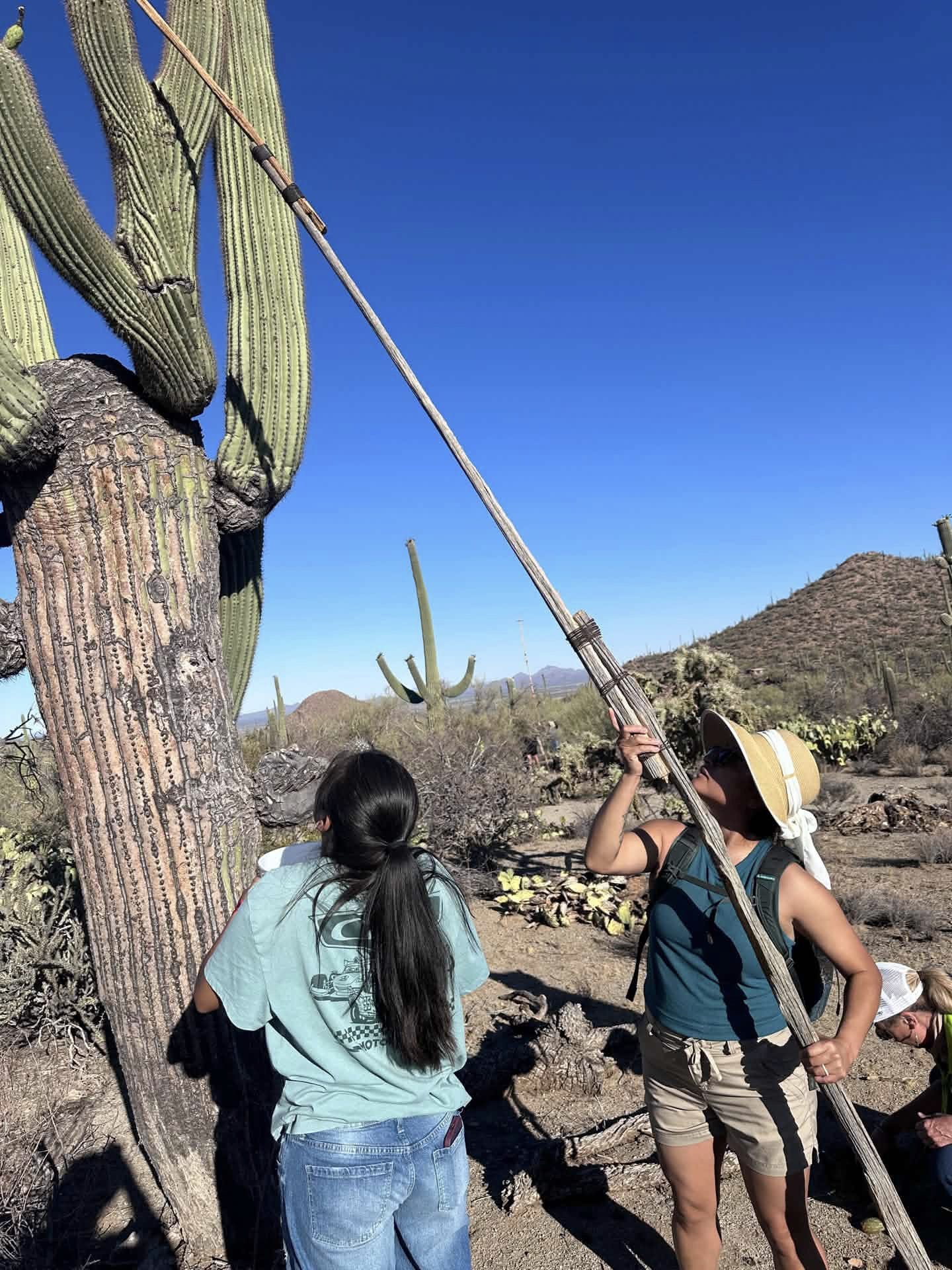
Someone would demonstrate how to pick. Eventually, the harvesting pole would be handed over.
“You saw it, you watched it. Okay, now it’s your turn.”
One of Mazey’s favorite memories came when she was around 12 or 13 years old.
She and her younger brothers were outside at their family’s home with not much to do when they realized it was bahidaj season. Rather than spend the day inside watching television, they came up with another plan.
“Hey, let’s go,” Mazey remembers them saying. “Let’s go picking.”
There was an old harvesting pole leaning against the house. They found what they needed and made a smaller one for her younger brother.
There was only one problem.
They could not find their dad’s wire.
Their dad was asleep on one of his days off, and the kids were convinced waking him up to ask would end with him telling them no.
So Mazey improvised.
“I got my hair ties and I stole a couple from my sister,” she said. “She yelled at me later on for taking them.”
They tied everything together, grabbed their water and chose a direction toward the mountains.
Before leaving, they took one of their mom’s good bowls.
“She was so mad,” Mazey said.
And then they were off.
The siblings walked out toward the mountains and started picking.
Mazey does not remember exactly how long they were gone. What she does remember is watching the sun move across the sky.
Eventually, the family back home started asking a fairly important question.
Where were all the kids?
Mazey first noticed her older brother walking toward the mountain looking for them.
Then, in the distance, she saw her dad’s big black truck coming toward them.
By that point, the kids had been gone for hours.
“We were always getting in trouble,” Mazey said. “We went to go get bahidaj because we didn’t tell anybody.”
But they had something to show for it.
Their parents looked over what they had gathered, and the kids eventually ate most of the fruit themselves.
They peeled the bahidaj open, left the peelings at the foot of the saguaro and ate the fruit fresh.
For Mazey, there is nothing quite like it.
“It’s very sweet,” she said. “It’s just like you’re eating a candy – a very sweet candy.”
Then she put it more simply.
“It tastes like heaven.”
“It tastes like heaven.”
Bahidaj remains Mazey’s favorite O’odham food. Part of what makes it meaningful to her is everything that happens before the first bite.
“You really put in the work when it comes to getting bahidaj,” she said.
There is the heat and rough terrain. There is watching where you step and trying not to fall into something covered in thorns. There is working with whoever is catching below you and hoping they do not drop the really good fruit you just managed to pick.
And if they do, Mazey knows exactly what comes next.
“Why did you drop that? That was a good one,” she remembers hearing. “Now the ants are going to get it. Hurry up, grab it.”
Her siblings and cousins were some of her first teachers. Her uncle and other relatives taught her along the way too.
Much of that knowledge was passed through watching and doing.
And sometimes through making mistakes.
As Mazey grew older, she began to recognize that those days in the desert were teaching her more than how to harvest.
Bahidaj taught her patience.
It taught her to pay attention to the ground beneath her, to the people around her and to the land she was gathering from.
It also taught her that not every family does things the same way.
“One family can do it differently. Another family can do it this way,” Mazey said. “No way is the correct way.”
For Mazey, being open to those differences is part of learning. Families may harvest differently or prepare foods differently, but the knowledge continues to move from one generation to another.
“To appreciate your surroundings because that’s home,” she said. “That’s really what it’s taught me.”
Now, Mazey is beginning to see that cycle from another place.
She was unable to go harvesting with her family this year, but her niece went with them for one of her first bahidaj pickings.
“That was pretty cool,” Mazey said.
The moment is small, but it represents something Mazey thinks about often: whether the next generation will have opportunities to know these traditions and decide for themselves what place those traditions will have in their lives.
Her grandfather played a large role in shaping how she thinks about that choice. Before he passed away, Mazey remembers him making a point to teach his grandchildren about Indigenous history and what previous generations experienced.
For Mazey, knowing that history makes having a choice today significant.
She wants younger O’odham people to know they can choose to learn their traditions, participate in them and carry them forward.
And if they choose differently, she believes they should have that choice too.
“That’s what our ancestors fought for,” Mazey said, “for you to have that choice and that option to practice your traditions.”
Still, she finds herself excited when bahidaj season returns.
She sees families posting their harvests, community gatherings and bahidaj camps. Another summer comes, people head back into the desert, and another O’odham New Year begins.
For Mazey, harvesting carries patience, discipline and responsibility. But it also creates time to be together.
Those are the memories she carries from being a kid, the siblings and cousins beside her, watching the people who knew what they were doing and eventually being handed the pole herself.
Now, another generation is beginning to watch.
“All these things are going to come, pass by you,” Mazey said. “But those cactus and that bahidaj, that’s always going to be there every year.”
The people beside her may change. The younger ones eventually become the ones showing someone else what to do.
But each season offers another chance to return.
To watch.
To learn.
And, when it is your turn, to pick.